Are Your Herb Sauces Just a Matrix of the Same Six Ingredients
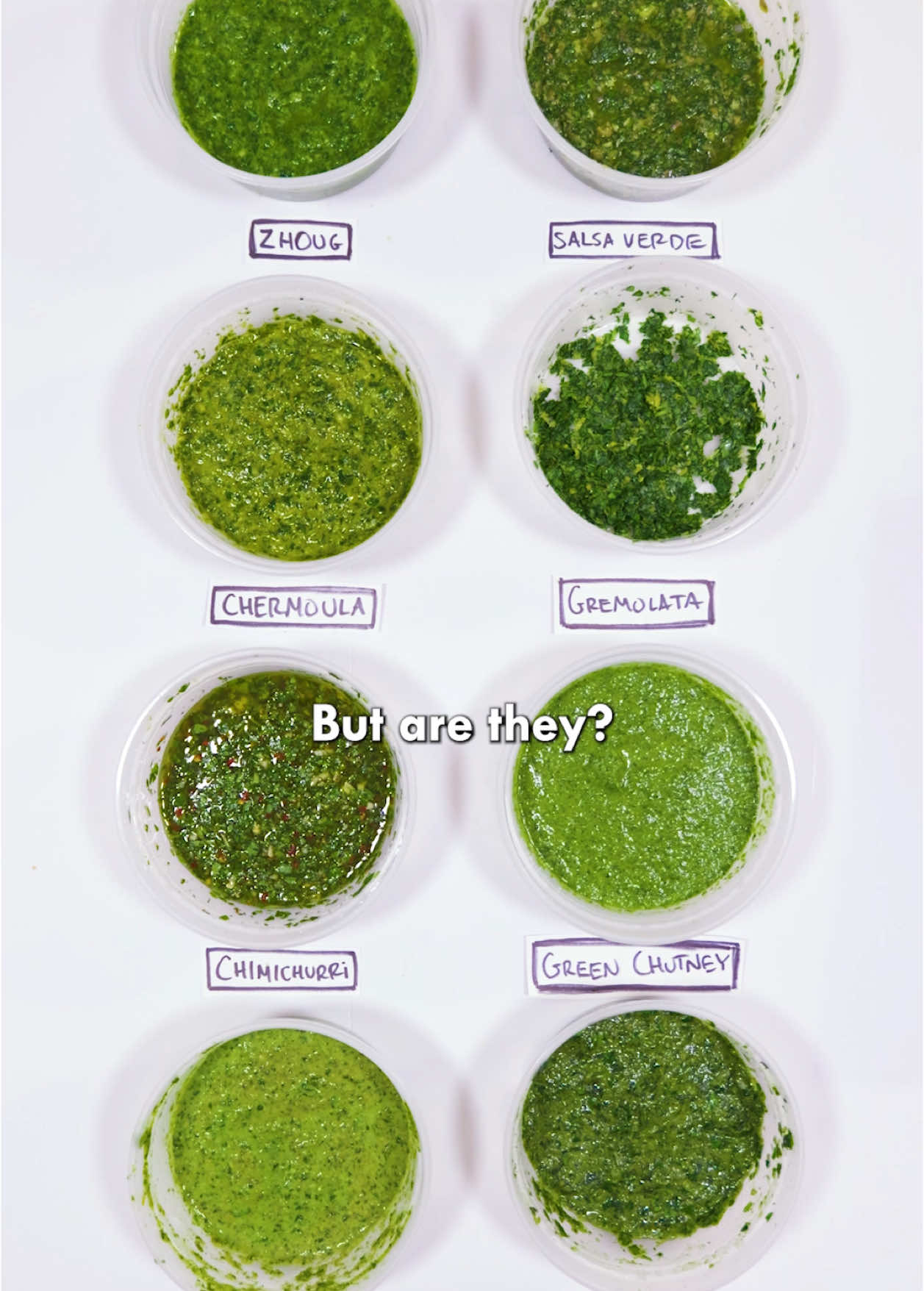
There are way too many green sauces in the world that sort of all look the same. Look into the display case of any modern deli or scroll through any social media feed, and you will see container after container of the same uniform, bright emulsion. It is an aesthetic monoculture. But are they actually the same?
I wanted to find out. I lined up eight distinct green sauces on a white surface, treated them like variables in an equation, and broke them down to their elemental parts.
The result? Eye-opening.
[Parsley + Red Wine Vinegar + Olive Oil + Garlic + Chili + Oregano] = Chimichurri
If you take that basic Argentinian chimichurri framework and replace the vinegar with lemon juice, then swap out the chili and oregano for capers and anchovy, you suddenly have an Italian salsa verde. The structural profile changes entirely based on the acid and the umami components.
To test the adaptability of the system, I shifted the variables again. I changed the parsley to cilantro, the lemon to lime, the olive oil to tomatillos, and swapped the capers and anchovy for onion and jalapeño. That simple substitution yields a classic Mexican salsa verde.
The Molecular Shift: From Gremolata to Zhoug
The formula gets even tighter when you strip away the liquid emulsifiers. Pure parsley, lemon zest, and garlic make an Italian gremolata. It is dry, punchy, and minimal.
But look what happens when you introduce oil and heat to that exact base. Add cilantro, olive oil, cumin, and green chili to the matrix. It immediately becomes a spicy green zhoug from Yemen.
[Zhoug Base] - [Green Chili] + [Paprika] = Moroccan Chermoula
The ratios dictate the geography. By replacing the green chili in the zhoug formula with paprika, the flavor profile shifts instantly toward a Moroccan chermoula. If you swap out the parsley entirely for mint, keep the lemon, and add green chili, ginger, and cumin, you land directly on a basic green chutney from India.
The Basil Constants
The final pair relies on a completely different herb base: basil.
Italian Pesto: Basil, olive oil, garlic, pine nuts, and parmesan cheese.
French Pistou: Basil, olive oil, and garlic.
By removing the dairy fat and the structural density of the pine nuts from a pesto, you are left with a lean, sharp French pistou. It is the same foundational herb engine, stripped down for efficiency.
The Chaos Variable: The "Swamp Thing"
To prove that these sauces rely on precise isolation to maintain their identity, I ran a final experiment. I combined a single spoonful of every single green sauce together into one container.
The result? Predictable.
I called it the Swamp Thing. It possessed a completely generic green flavor that tasted exactly like everything else on the table simultaneously. When you maximize every variable at once, you hit a point of sensory cancellation. Precision matters. If you do not respect the ratios, you are just making swamp water.