Why Your Home-Cooked Omelettes Fail—and the Precise Ratios That Fix Them
Most home cooks treat the humble omelette like a game of chance. You crack a few eggs into a hot pan, stir them around, fold the mass over, and hope for the best. The result? Mediocrity. You end up with a dry, rubbery envelope of overcooked protein that relies entirely on a heavy hand of cheese to make it palatable.
I wanted to change that. I stood in my kitchen and systematically broke down four distinct global omelette styles to map their core formulas, variables, and structural integrity.
It turns out that perfect eggs are not a matter of luck. They are a science of time, temperature, and technique.
The Low-Heat Emulsion: The French Omelette
The classic French omelette is the ultimate test of control. It demands an absolute mastery of low heat and continuous movement.
The formula begins with standard parameters: eggs scrambled with a pinch of salt. The critical variable is the choice of fat and heat level. I melted a pat of butter in a non-stick pan over low heat, ensuring it never browned.
[Low Heat + Constant Stirring + Tight Roll] = French Custard Structure
The technique requires you to pour the eggs and stir continuously with a spatula until they just begin to firm up into tiny curds. Once the eggs form a loose, homogenous mass, you spread them evenly across the pan and carefully fold them over into a tight cylinder. Tilting the pan helps guide the roll.
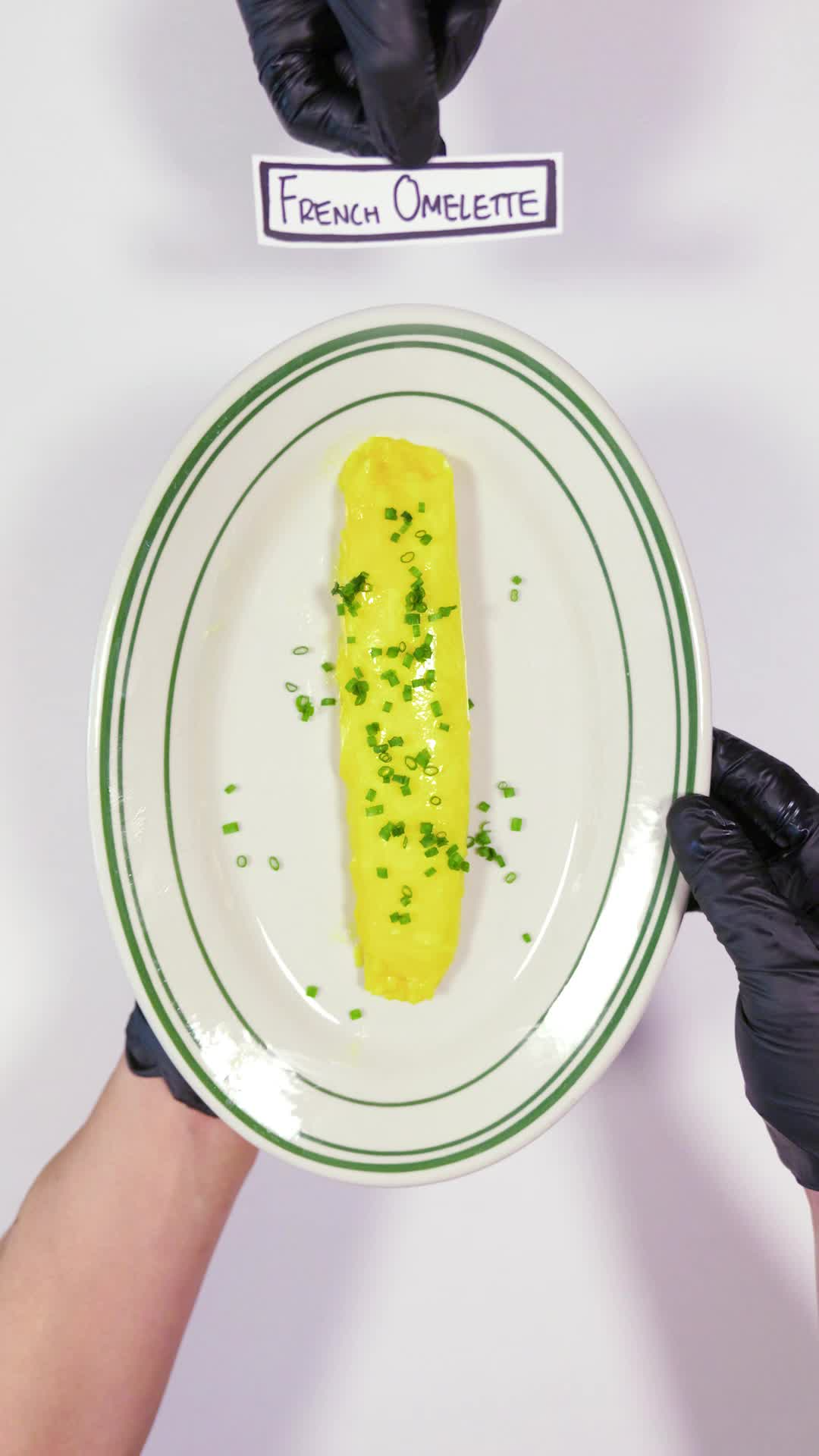
Plated seam-side down, rubbed with extra butter for a glossy sheen, and garnished with chives, the structural result is flawless. No color on the outside. A smooth, pale-yellow skin. When you slice into it, the interior reveals a perfectly custardy texture.
The Diner Standard vs. The Layered Matrix
If you prefer texture over a uniform custard, the parameters shift toward a higher thermal energy.
The Diner Omelette: Melt butter over medium heat. Pour the eggs and slowly pull the edges inward with a spatula, allowing the runny, uncooked egg on top to slide underneath. Add your toppings, flip it in half, and finish with black pepper. It is your basic, reliable diner standard.
The Tamagoyaki: Move into the Japanese flavor matrix. Swap the salt for sugar, mirin, and dashi. Instead of a pat of butter, dip a paper towel in oil and lightly coat the pan over medium heat.
The technique for Tamagoyaki is mathematical. Pour a thin layer of egg, let the edges set, fold the sides inward, and roll it from the bottom up. Move the roll to the top of the pan, oil the surface again, pour another thin layer of egg—making sure it runs underneath the first roll—and repeat the process.
Once cooked, you slice off the rough ends and section it into even blocks. The result is a beautifully layered, sweet, and savory rolled structure.
[Soy/Dashi Variables] + [Layered Thin Sheets] = Tamagoyaki Form
The High-Heat Fry: Kai Jeow
The final method completely flips the traditional Western paradigm of egg cookery. It trades gentle heat for pure, chaotic frying.
To make a traditional Thai Kai Jeow, you alter the flavor profile by scrambling the eggs with fish sauce and white pepper. The fat variable changes dramatically: you fill a pan with a generous amount of high-heat frying oil and bring it up to a high temperature.
You simply pour the eggs directly into the shimmering oil. The egg puffs up instantly, sizzling violently as the water content turns to steam. Once the bottom is crisp and golden brown, you flip it to crisp the other side.
Plated and dabbed with a paper towel to remove excess oil, you are left with a deep-fried omelette that is remarkably airy on the inside and shatteringly crisp on the outside.
The Technical Takeaway
Egg proteins are highly sensitive to variable changes. If you want a smooth, custardy texture, you must limit your thermal input and keep the curds small. If you want a crispy, lifted structure, you need high heat and plenty of fat to create steam pockets.
Stop flipping your eggs blindly. Pick your style, isolate your variables, and control the heat.