The Sub-250g Showdown DJI Mini 5 Pro vs. Antigravity A1—Which Mini Drone Wins
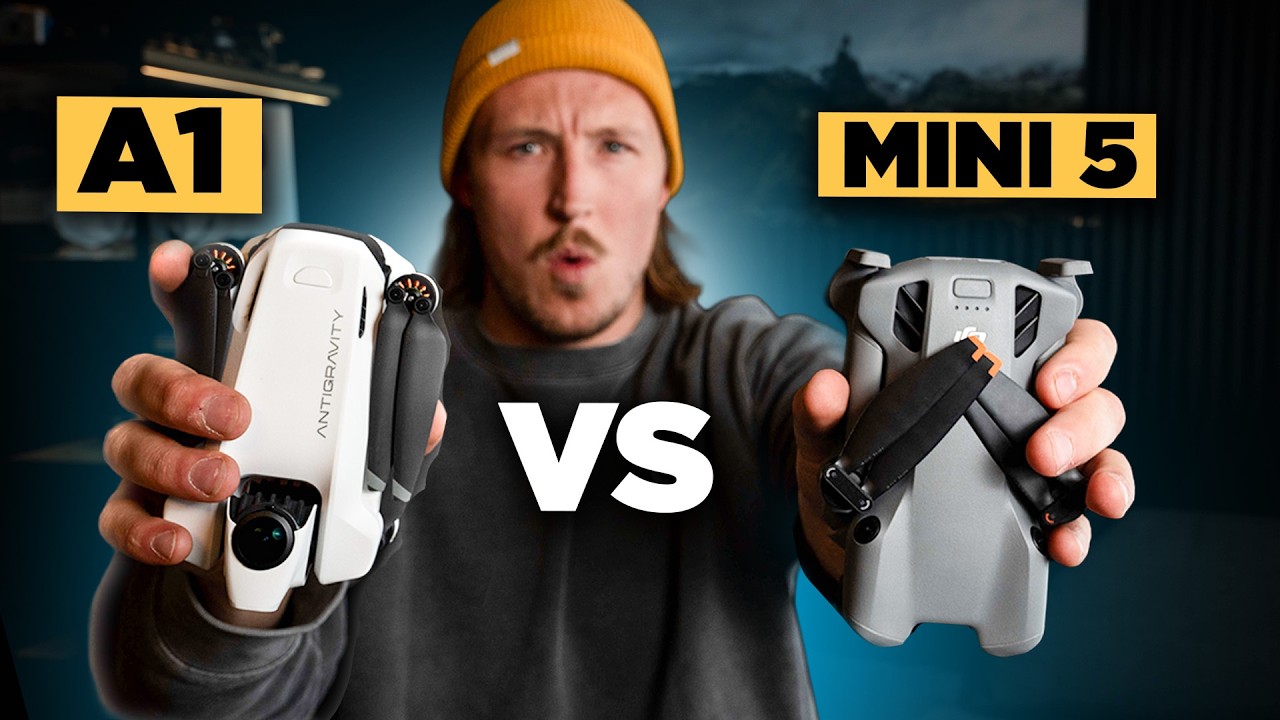
Choosing a drone used to be simple, but the sub-250g market has completely evolved. These lightweight crafts are no longer just toys for casual flyers—they are full-blown production tools. Today, we are putting two of the absolute heaviest hitters in the lightweight space head-to-head: the conventional powerhouse, the DJI Mini 5 Pro, and the radical newcomer, the Antigravity A1 (co-developed with Insta360).
Both of these drones offer an incredible fold-out design that packs down into a footprint small enough to toss in a jacket pocket. But beneath the surface, they approach the concept of flight from completely opposite directions. One is a cinematic scalpel; the other is a literal masterclass in immersion.
The Weight Debate: Regulating the Micro Space
The magic number in the drone world is 250 grams. Staying under this limit triggers a much more lenient set of rules and regulations across the globe.
The Antigravity A1: Easily clears this legal hurdle, comfortably registering underneath the 250g baseline.
The DJI Mini 5 Pro: Bizarrely registers several grams over the limit. While it features a factory sticker claiming sub-250g status, technically it falls outside the boundary. Agencies like EASA in Europe are working on small weight tolerances to fix this issue , but for absolute legal peace of mind, the A1 holds an undeniable design advantage.
Hardware Breakdown: Quick-Release vs. Retractable Gear
When you are tracking shots in high-impact environments, your gear needs to be simple to maintain.
The Mini 5 Pro captures a massive win here thanks to its quick-release propellers. If you clip a tree branch or have a rough landing on a backcountry trail, changing the props takes a couple of seconds—just press, twist, and the blade is off. The Antigravity A1 utilizes a more traditional two-screw mount per propeller , making field repairs a bit more tedious.
However, the A1 sports one of the absolute coolest mechanical features I have seen on a micro drone: retractable landing gear. The legs deploy for takeoff and automatically tuck into the chassis once the drone is airborne , ensuring its panoramic 360° lens array has a completely unobstructed view of the world.
Technical Chase: Single Sensor vs. Total Sphere
The camera specs on both rigs are completely mind-blowing compared to where drone tech was just five years ago.
Feature SpecDJI Mini 5 ProAntigravity A1Video Resolution4K at 120fps8K at 30fps (360° Sphere)Aperture / Sensor1-inch, f/1.8Dual 1/1.28-inch, f/2.2Color Log ProfileDlog-M (Flat 10-bit color)Standard PanoramicFlight Time (Stated)36 mins (Standard) / 52 mins (Extended)24 mins (Standard) / 39 mins (Extended)Max Range (FCC)20 km10 km
The Mini 5 Pro is built purely for pristine image fidelity. Its massive 1-inch sensor combined with a fast f/1.8 aperture offers cleaner performance in low light and vastly superior dynamic range. Plus, shooting in Dlog-M gives you a beautifully flat canvas to grade your footage and establish your own custom cinematic look in post-production.
The Antigravity A1 relies on two 1/1.28-inch sensors pointing top and bottom. It captures an entire 8K sphere of the world all the time. While your cropped exports will realistically drop down to somewhere between 1080p and 4K, the creative flexibility this provides is unparalleled.
The Flight Experience: Classic Control vs. Immersive Cockpit
This is where the user experience completely splits. Flying the Mini 5 Pro is a very standard affair. You look at a screen attached to a classic twin-stick controller. It is clean, reliable, and gives the operator better range and obstacle connection through heavy barriers like houses or dense tree cover.
Flying the Antigravity A1 is a spiritual experience. You strap on a pair of FPV goggles and navigate using a motion controller. Because the craft tracks in 360 degrees, you can turn your head inside the goggles to look in any direction—left, right, or straight down—totally independent of the way the drone is flying. It legitimately makes you feel like you are sitting inside the cockpit of a jet fighter. It is so incredibly intuitive and easy to learn that a beginner can master it in minutes.
The only major catch? At the moment, the A1 lacks a traditional twin-stick controller mode, meaning the drone can only fly in a forward trajectory. You cannot fly sideways or backward yet, though a classic controller update is currently in development. Additionally, if you want an immersive FPV setup on a sub-250g DJI drone, the answer is unfortunately no. While older models like the Mini 3 and Mini 4 support FPV goggles, DJI has strangely omitted goggle compatibility for the Mini 5 Pro.
Post-Production: Frame on the Fly vs. Shoot Now, Frame Later
The editing workflow reveals the true intent of both devices.
With the DJI Mini 5 Pro, you compose your shot in real-time while flying. What you shoot is what you get. It means less time sitting behind a computer desk editing, but it requires massive precision during flight to execute flawless orbits or reveals.
With the Antigravity A1, you don't even have to worry about framing while you fly. You just focus on enjoying the path of the drone. Because the A1 records everything simultaneously , you simply open up the desktop or mobile editing app later, select your subject, and use keyframes to design your transitions. Want to face forward, flip back, or pull out into a "tiny planet" perspective from the exact same clip? You can do it all in post-production. The built-in subject tracking is so accurate that orbiting around a moving surfer or a massive cliffside requires zero piloting skill.
The Final Verdict: Adrenaline or Precision?
Both of these drones are absolute triumphs of microengineering, but they serve two completely distinct masters.
If your primary objective is to capture pristine, high-fidelity landscape sequences, maximize your battery life, and retain a simple, traditional post-production workflow, grab the DJI Mini 5 Pro. It remains the golden standard for traditional commercial cinematography in a micro package.
But if you are chasing a breathtaking, fully immersive flight experience that genuinely redefines how you look at the world, the Antigravity A1 is the undisputed king. The ability to just fly, have fun, and paint your creative framing angles later in post makes it an absolute game-changer for solo creators and action junkies alike.
Clear your schedule, pick your style of flight, and go capture your world. The horizon is wide open.
Choosing a drone used to be simple, but the sub-250g market has completely evolved. These lightweight crafts are no longer just toys for casual flyers—they are full-blown production tools. Today, we are putting two of the absolute heaviest hitters in the lightweight space head-to-head: the conventional powerhouse, the DJI Mini 5 Pro, and the radical newcomer, the Antigravity A1 (co-developed with Insta360).
Both of these drones offer an incredible fold-out design that packs down into a footprint small enough to toss in a jacket pocket. But beneath the surface, they approach the concept of flight from completely opposite directions. One is a cinematic scalpel; the other is a literal masterclass in immersion.
The Weight Debate: Regulating the Micro Space
The magic number in the drone world is 250 grams. Staying under this limit triggers a much more lenient set of rules and regulations across the globe.
The Antigravity A1: Easily clears this legal hurdle, comfortably registering underneath the 250g baseline.
The DJI Mini 5 Pro: Bizarrely registers several grams over the limit. While it features a factory sticker claiming sub-250g status, technically it falls outside the boundary. Agencies like EASA in Europe are working on small weight tolerances to fix this issue , but for absolute legal peace of mind, the A1 holds an undeniable design advantage.
Hardware Breakdown: Quick-Release vs. Retractable Gear
When you are tracking shots in high-impact environments, your gear needs to be simple to maintain.
The Mini 5 Pro captures a massive win here thanks to its quick-release propellers. If you clip a tree branch or have a rough landing on a backcountry trail, changing the props takes a couple of seconds—just press, twist, and the blade is off. The Antigravity A1 utilizes a more traditional two-screw mount per propeller , making field repairs a bit more tedious.
However, the A1 sports one of the absolute coolest mechanical features I have seen on a micro drone: retractable landing gear. The legs deploy for takeoff and automatically tuck into the chassis once the drone is airborne , ensuring its panoramic 360° lens array has a completely unobstructed view of the world.
Technical Chase: Single Sensor vs. Total Sphere
The camera specs on both rigs are completely mind-blowing compared to where drone tech was just five years ago.
Feature SpecDJI Mini 5 ProAntigravity A1Video Resolution4K at 120fps8K at 30fps (360° Sphere)Aperture / Sensor1-inch, f/1.8Dual 1/1.28-inch, f/2.2Color Log ProfileDlog-M (Flat 10-bit color)Standard PanoramicFlight Time (Stated)36 mins (Standard) / 52 mins (Extended)24 mins (Standard) / 39 mins (Extended)Max Range (FCC)20 km10 km
The Mini 5 Pro is built purely for pristine image fidelity. Its massive 1-inch sensor combined with a fast f/1.8 aperture offers cleaner performance in low light and vastly superior dynamic range. Plus, shooting in Dlog-M gives you a beautifully flat canvas to grade your footage and establish your own custom cinematic look in post-production.
The Antigravity A1 relies on two 1/1.28-inch sensors pointing top and bottom. It captures an entire 8K sphere of the world all the time. While your cropped exports will realistically drop down to somewhere between 1080p and 4K, the creative flexibility this provides is unparalleled.
The Flight Experience: Classic Control vs. Immersive Cockpit
This is where the user experience completely splits. Flying the Mini 5 Pro is a very standard affair. You look at a screen attached to a classic twin-stick controller. It is clean, reliable, and gives the operator better range and obstacle connection through heavy barriers like houses or dense tree cover.
Flying the Antigravity A1 is a spiritual experience. You strap on a pair of FPV goggles and navigate using a motion controller. Because the craft tracks in 360 degrees, you can turn your head inside the goggles to look in any direction—left, right, or straight down—totally independent of the way the drone is flying. It legitimately makes you feel like you are sitting inside the cockpit of a jet fighter. It is so incredibly intuitive and easy to learn that a beginner can master it in minutes.
The only major catch? At the moment, the A1 lacks a traditional twin-stick controller mode, meaning the drone can only fly in a forward trajectory. You cannot fly sideways or backward yet, though a classic controller update is currently in development. Additionally, if you want an immersive FPV setup on a sub-250g DJI drone, the answer is unfortunately no. While older models like the Mini 3 and Mini 4 support FPV goggles, DJI has strangely omitted goggle compatibility for the Mini 5 Pro.
Post-Production: Frame on the Fly vs. Shoot Now, Frame Later
The editing workflow reveals the true intent of both devices.
With the DJI Mini 5 Pro, you compose your shot in real-time while flying. What you shoot is what you get. It means less time sitting behind a computer desk editing, but it requires massive precision during flight to execute flawless orbits or reveals.
With the Antigravity A1, you don't even have to worry about framing while you fly. You just focus on enjoying the path of the drone. Because the A1 records everything simultaneously , you simply open up the desktop or mobile editing app later, select your subject, and use keyframes to design your transitions. Want to face forward, flip back, or pull out into a "tiny planet" perspective from the exact same clip? You can do it all in post-production. The built-in subject tracking is so accurate that orbiting around a moving surfer or a massive cliffside requires zero piloting skill.
The Final Verdict: Adrenaline or Precision?
Both of these drones are absolute triumphs of microengineering, but they serve two completely distinct masters.
If your primary objective is to capture pristine, high-fidelity landscape sequences, maximize your battery life, and retain a simple, traditional post-production workflow, grab the DJI Mini 5 Pro. It remains the golden standard for traditional commercial cinematography in a micro package.
But if you are chasing a breathtaking, fully immersive flight experience that genuinely redefines how you look at the world, the Antigravity A1 is the undisputed king. The ability to just fly, have fun, and paint your creative framing angles later in post makes it an absolute game-changer for solo creators and action junkies alike.
Clear your schedule, pick your style of flight, and go capture your world. The horizon is wide open.